YOUR EYES
Close to a coin toss
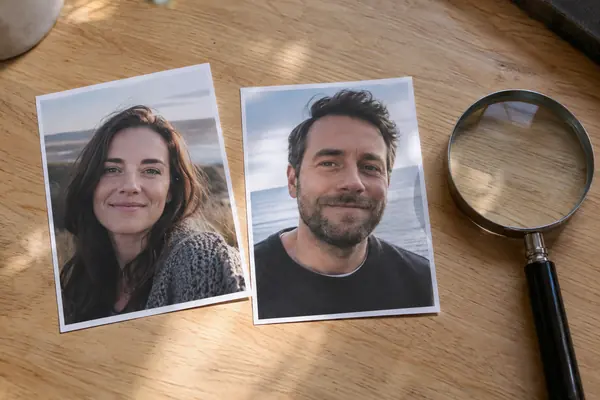
In a study of 315 people, AI-made faces were classed correctly 48.2% of the time, about chance. Training lifted it only to 59%.
See the numbers
 aiphotofun
AI PHOTOS, LABELLED
LOOK AGAIN before you share
AI pictures can now pass for real photos.
In one study, people judged AI-made faces correctly less than half the time. So the industry is turning to labels instead: signed records, hidden watermarks and plain tags that say how a picture was made.
Updated
Read a labelTHE SHORT ANSWER
Looking hard is not a reliable test any more.
Three kinds of label do the work instead.
YOUR EYES
In a study of 315 people, AI-made faces were classed correctly 48.2% of the time, about chance. Training lifted it only to 59%.
See the numbersCONTENT CREDENTIALS
The open C2PA standard attaches a signed record of how a file was made and edited. Change the picture and the record no longer matches.
How to checkTHE LAW
Under the EU AI Act, AI-made content must be identifiable and deepfakes clearly labelled. The transparency rules apply from August 2026.
What the rules sayREAD A LABEL
Photo files can carry a standard tag for how the picture was made, used inside Content Credentials. Pick one to see what it means. The bar shows how much of the picture came from AI.
Based on the IPTC Digital Source Type vocabulary. Not every app writes these tags, and some sites remove them.
TWO NUMBERS WORTH KNOWING
One figure on how often people meet deepfakes,
one on how well we can tell.
43%
Saw at least one deepfake in six months
Ofcom found 43% of people aged 16+ said they had seen at least one deepfake online in the last six months, rising to 50% of children aged 8 to 15.
UK ADULTS · OFCOM 2024
9%
Confident they could spot one
Fewer than one in ten people aged 16+ said they were confident in their ability to identify a deepfake. Children aged 8 to 15 were more likely to say so, at 20%.
CONFIDENCE · OFCOM 2024
In a 2022 PNAS study, people also rated AI-made faces as slightly more trustworthy than real ones: 4.82 against 4.48 on a seven-point scale.
FOUR HABITS TO TRY
None of these needs special skills. They are about using the labels that already exist, and knowing what they can and cannot tell you.
A Content Credentials pin, or a platform's AI label, means the file carries information about how it was made. Open it to see the history.
Content Credentials verify tools read a file's signed record and show whether it was created or edited with AI, and whether it has been tampered with.
Metadata can be removed, so a missing label does not mean a picture is real. It just means you have no record either way.
If you share an AI-made or AI-edited picture, say so in the caption, especially if it shows a real place or a person.
WHAT LABELS CAN AND CANNOT DO
The C2PA explainer is clear that Content Credentials do not judge whether a picture is true. They show whether the record is well formed, untampered and signed by a known signer. Because metadata can be stripped, the standard also allows invisible watermarks and fingerprints so the record can be found again.
Ofcom describes the same toolkit for tech firms: invisible watermarks, metadata attached at creation and visible AI labels on upload, alongside detection and clear platform rules. It says there is no silver bullet, and that tackling harmful deepfakes needs several approaches together.
Questions
Not reliably. In a 2022 study published in PNAS, 315 people classed real and AI-made faces correctly 48.2% of the time, close to chance. With training and feedback, a new group reached 59%.
An open standard from the Coalition for Content Provenance and Authenticity (C2PA). A signed record travels with the file, describing its origin, edits and any use of AI. Any change to the file or the record breaks the match.
Not necessarily. The C2PA explainer confirms that provenance metadata can be removed, so a missing label only means there is no record. That is why the standard also supports invisible watermarks and fingerprint lookups.
In the EU, the AI Act says providers of generative AI must make AI-made content identifiable, and deepfakes must be clearly and visibly labelled. The European Commission says these transparency rules apply from August 2026.
Ofcom defines deepfakes as videos, pictures or audio clips made with artificial intelligence to look real. Many are harmless fun or satire, but some are used to demean people, run scams or spread false information.
Sources
ABOUT THIS NAME
aiphotofun.com is part of the DoodleSale portfolio. It isn't in an auction right now, but you can ask about leasing it.